MACHBORNEarchive
MB-ARCH-0100 CAMPAIGN RECORD · OPEN DISTRIBUTION LIVING DRAFT AS OF LS 212

The Mach Wars

Campaign record: seven dated operations, LS 189 to LS 208, each given as the chain of links it depended on and what the other side did about each one.

Source: docs/lore/09_mach_wars.md · rendered by build_machborne.py · last updated 2026-08-29. Edits to the lore file flow to this page.

Seven operations, LS 189 to LS 208, chosen because each one is taught. The Mach Wars have no front and no declaration; they are fought by contracted Machborne companies for nodes, foundries and Break salvage, and what a company learns on one ground it drills on the next. Each record below gives the ground first, then the objective, then the chain: the sequence of links the operation depended on, who held each link, and what the other side did about it. The chain is the point. No operation in this record was one action, and no defence that broke one was a wall.

Sources are company after-action reports, Meridian contest ledgers and survey bulletins. Company names follow the guild style guide; operator callsigns are as recorded. Casualties are given as the companies give them, as Cores and operators, because that is the unit the wars are paid in.

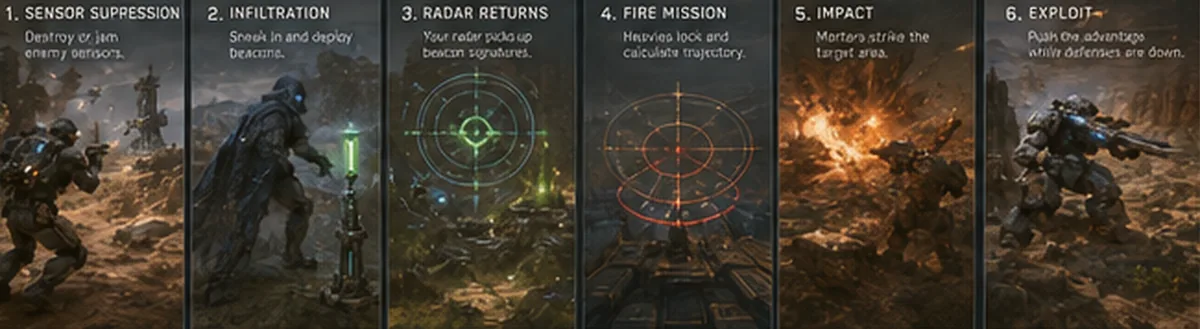
Six panels of a beacon-artillery chain: sensor suppression, infiltration, radar returns, fire mission, impact, exploit
Concept The beacon-mortar chain in six panels, from a concept board. Blind, insert, keep, solution, fire, exploit: the Covenant's Marked Ridge, and the mirror every defence drills.
MB-OPS-01OPERATION RECORDLS 189

The Crater Chain

LS 189 · Cairn Node Station · Cairn Detachment (Frontier Ascendancy contract) against Relay Four (Helix Concord contract) · the first contested node of the Mach Wars

Ground

The Cairn ring at low gravity: bare regolith in broad, shallow craters, the two cargo terminals at opposite points of the ring, the interior transit tube between them. The anchor's gradient distorts Burn Arcs near the polar housing, which neither company had fought under before.

Objective

Relay Four held the node's control terminal for the Concord scheduling authority. The Ascendancy, refused a transit slot to the boundary zone, contracted Cairn Detachment to take the terminal's Core and hold the ring until the schedule was renegotiated. Both blocs described the action as a contract dispute. Historians mark the Mach Wars from it.

Chain

A Split Run, the Frontier's signature, run for the first time on ground nobody had mapped.

LinkActorActionWhat the other side did
SpotDetachment scout (Strider, Dry Creek)Crossed the first crater on Glide to draw a sweep and read the Concord sensor pattern from where the drones turned.Relay Four's drones turned early; the pattern was read in four seconds.
CloseTwo Runners (Kestrel-Nine on the Craters, Longtail on the Road)Left the terminal at the same moment on two Breaklines.Relay Four committed its interceptor pair to the Road. Longtail became the decoy.
SoftenDetachment escort (two Rangers)Engaged the interceptor pair at the Road's second bend from the crater rim above it.One interceptor turned back for the terminal; too late by nine seconds.
SecureKestrel-NineRose off the third crater rim, took the anchor's distortion on a Burn Arc no one had flown, and arrived at the terminal roof hatch with one Burn left.Relay Four's reserve was one Engineer with a Shard Cannon inside the Station; the Runner entered by the roof, not the tube.

Outcome

Core lifted at nineteen minutes, Detachment held the ring for eleven days, schedule renegotiated. The anchor distortion that Kestrel-Nine flew through is in the Cairn brief as a note and on no map; the Runner's telemetry is the survey services' only measurement of it.

Ledger

Detachment: one Core (the escort Ranger's, lost on the Road), two operators. Relay Four: one Core (the terminal's), no operators. Both companies' reports say the same thing in different words: nobody had fought at low gravity before, and the Burn Arcs were longer than anyone's lead.


MB-OPS-02OPERATION RECORDLS 191

The Yard Run

LS 191 · Verrin, Mach-1 foundry · Sable Choir (Null Collective) against Quench Foundry Guard (Helix Concord contract) · the first silent Core run

Ground

The foundry's crucible hall and the gravel training plain, the Yard, under its cooling stacks. High gravity: short Burn Arcs, hard landings, a surface that gives little back and punishes every rise. The Core Station was the crucible hall's dispatch cradle, where a finished Core waits for its first mount.

Objective

A crucible-fresh Mach-1 Core, unstamped, in the dispatch cradle for eleven hours between growth and certification. The Collective wanted a foundry Core it could compare with its own. It had never asked, and the Concord would not have sold one.

Chain

Not a Night Switch. There was no jamming at all; the foundry's grid was left running, and the Concord's own after-action report is titled We Saw Nothing Because Nothing Was Loud.

LinkActorActionWhat the other side did
SurveyNull drone, passiveEight days of listening from the stack tops. Learned which of the Yard's nine posts had a blind arc under the third stack and how long each drone sweep took to turn.The sweeps were on schedule. That was the information.
BlindNull infiltrator (Unread, stripped Strider)Did not jam or destroy the post. Walked through its blind arc on Traction during a sweep turn, below every threshold a sensor operator was watching for.Nothing registered. A sensor operator watching for the Break saw a foundry worker.
EnterUnreadCrucible hall by the cooling gallery, on foot.The hall's guard, one Ranger, was watching the hall doors.
LiftUnreadCore out of the dispatch cradle: the physical act, forty seconds, alarm at the end of it.Alarm raised. The Guard committed interceptors to the Yard's fast lines, the three rims a Runner would use.
ExitUnreadTook the slow safe line, the gravel road along the stack bases, at a walking Glide, never above the Break. Was passed twice by interceptors moving at speed towards where a Runner should have been.The Guard's interceptors held the fast lines for six minutes. The Core left Verrin on a Null hull that had been docked, on schedule, since the previous week.

Outcome

Core lost. Verrin's signature readers have since listed a class of Core the foundry did not make: Sable-modified Mach-1, coupling signature readable with a component the instruments have no name for.

Ledger

Sable Choir: none. Quench Foundry Guard: one Core, no operators, and the foundry's dispatch procedure, which now certifies in the crucible hall. The Concord's report, distributed to every contract company on the strand, is the origin of the doctrine that a sensor grid must be read by someone who knows what slow looks like.


MB-OPS-03OPERATION RECORDLS 193

The Marked Shelf

LS 193 · Serac Belt, near boundary · Keld Ferrous (Iron Covenant) against Marrow Salvage (Frontier Ascendancy contract) · the beacon-mortar chain, as the Covenant considers it should be run

Ground

An ice world on the Break's near boundary. A salvage camp on a shelf of blue ice above a crevasse field, with the camp's Core Station in a cut tunnel and its sensor posts along the shelf lip. Below the shelf, a kilometre of broken ice; above it, a ridge Frontier operators called unreachable because they would not have bothered.

Objective

The camp held four Break Cores from the previous season's salvage. The Covenant had bought two at the price the Frontier set and decided it would not buy the rest.

Chain

The Marked Ridge, six links. The Covenant column took nine days to reach the ridge and thirty-one minutes to use it.

LinkActorActionWhat the other side did
BlindCovenant raiding pair (Rangers)Killed the westernmost sensor post on the shelf lip with a Vector Cannon from across the crevasse field, at the limit of its range.Marrow Salvage's Engineer went to repair it. That was the gap.
InsertInfiltrator (Tamper, Strider, painted grey)Crossed the crevasse field on Glide during the repair, climbed the shelf's blind end, and set a Target Beacon at the tunnel mouth.A Frontier scout saw a grey Strider and reported "one of ours, wrong paint."
KeepCovenant Engineer on the ridgeHeld a Relay Beacon online on the ridge crest against a Frontier drone sweep, with a Shield Pack.The sweep found the relay. The Shield held for the time the solution needed, which was the whole point of the Shield.
SolutionBulwark pair (Ballast, Counterweight) on the ridgeRead the beacon's mark through the relay.Marrow Salvage jammed the beacon, twelve seconds too late; the solution was already laid.
FireSame pair, Gravity MortarsEleven rounds onto the tunnel mouth and the sensor line.No counter-battery position existed; the Frontier had not thought a Bulwark could get onto the ridge. Two Titans had towed them.
ExploitHammer pair and a Runner (Rivet)Down the ridge on the shelf's blind side into the repair chaos; the Runner walked the tunnel.The reserve was the Engineer, still at the sensor post.

Outcome

Four Break Cores taken, camp abandoned. The Covenant published the telemetry. The Frontier's after-action report is one paragraph and ends: they brought a ridge with them.

Ledger

Keld Ferrous: one Titan (crevasse, on the withdrawal), one operator. Marrow Salvage: four Cores, three operators, the camp. The Frontier's counter-doctrine, that a Covenant plan interrupted before it is set is a slow column in the open, dates from the nine days nobody interrupted this one.


MB-OPS-04OPERATION RECORDLS 196

Tessel Counter-Battery

LS 196 · Tessel Node Station · Second Reading (Helix Concord contract) against Holdfast Cadre (Iron Covenant) · the defence that produced the Accord

Ground

The basalt terraces below the station, stepping down to the methane sea. The Covenant held the upper terraces and the ridge above them with a Titan and a Bulwark battery; the Concord held the station and the two terraces under it. Between, three risers that launch a Glide and a long flat that stops one.

Objective

The Covenant intended to take the node outright by the method of Operation 3: mark the station, break it with mortar fire, walk in. The Concord intended to keep it. The wider objective, which neither company was told, was that both blocs were spending more on Tessel than the node earned.

Chain

The defensive mirror of the Marked Ridge: six counters, of which Second Reading landed four. The Concord teaches it as the chain you break, not the chain you run.

LinkActorActionWhat the other side did
Protect sensorsConcord Engineer pairLanterns seeded on the two risers a Covenant raid would use, and the base posts pulled back behind the station wall where a Vector Cannon could not reach them from the terraces.The Covenant raid killed a lantern, not a post. The grid stayed up.
Sweep for markersSensor operator (Second Reading, the company's namesake)Read every crossing on the lantern line and classified one as slow, wrong paint: an infiltrator on Traction. The beacon was found nine seconds after it was set.The Covenant beacon transmitted for nine seconds.
Raid the relayConcord Strider pairNot attempted; the Covenant relay was on the ridge behind the battery and the pair would not have come back.The relay stayed up. This counter was conceded.
Jam the beaconConcord jammerBeacon spoofed to a point on the flat, two hundred metres short of the station.The Covenant battery laid its solution on the spoofed mark.
Counter-batteryConcord Bulwark (Datum), in the station's counter-battery position on the lower terraceRead the Covenant battery's position from the first salvo's arc, and fired on it before the second.Second salvo never came. One Covenant Bulwark, one Titan.
Hold a reserveTwo Rangers inside the stationWaited.The Covenant exploit column came down the risers into a station that was intact and expecting them, and turned back at the flat.

Outcome

Node held. Nothing taken by either side. The two blocs' accounts of the season were compared at Meridian the following year and both found to be losses; the Sanctioned Contest Accord of LS 197 was signed in the hall with the best telemetry coverage on the Lattice, and Tessel is the reason it says what it says.

Ledger

Second Reading: one Engineer (the lantern raid). Holdfast Cadre: one Core, one Titan, three operators. The counter-battery position on Tessel's lower terrace is now built into the station's design and copied by every node the Concord has fortified since.


MB-OPS-05OPERATION RECORDLS 203

Marrow, the Cable

LS 203 · Marrow Outer Station, deep boundary · Backwater Rail (Frontier Ascendancy) against Lee Chain (Null Collective) · a sanctioned contest, and the record

Ground

The dry basin under the dead tether: hardpan floor, dune field at the centre, the two anchor pylons with a Core Station at the top of each. The lower cable hangs from the sky and buries itself in the dunes. The Break's coupling is strongest here of any ground the Accord recognises.

Objective

A sanctioned BreakFlag under Meridian telemetry, three Cores to win, both companies contracted by their blocs to settle a salvage-share dispute without the cost of settling it. This is what the Accord is for and what the Mach Wars mostly are.

Chain

Lee Chain ran a Night Switch on every attack; Backwater Rail ran the Cable. The chain below is Backwater's third and deciding run, the one in the ledgers.

LinkActorActionWhat the other side did
SpotBackwater scout (Skerry, Razor)Drove the hardpan at speed through the Null jamming window to draw the decoy signatures and count them. Three decoys; the real Null Runner was on the Lee Chain, slow.The Null jammer's window closed with the Razor still moving. Null's own Runner was intercepted on the dunes by the Backwater reserve.
CloseRunner (Halfmoon, Strider, Energy Pack)Climbed the tether cable on Burn from the dune field, rode its curve as a ramp, and ran it.Lee Chain's interceptor at the pylon top had a lead solution for the Lee Chain and the Hardpan. Not for the sky.
SoftenBackwater escortNothing to soften. The escort's job was to hold the reserve at the home pylon against the decoys.The decoys were decoys.
SecureHalfmoonOff the cable at its height, Dive onto the pylon platform, Core out of the Station with the Envelope at the edge of what it could hold.The Null Station guard fired once, behind the Runner, by the width of the Runner's speed.

Outcome

Third Core, contest to Backwater Rail, salvage share settled. Halfmoon's Dive off the cable was recorded by Meridian's certified instruments at 412 km/h, the fastest sanctioned speed on the Lattice. The Runner landed at zero Cell and walked the last ten metres.

Ledger

Backwater Rail: none; the contest's Cores are returned under the Accord. Lee Chain: none. The Break took the basin the following year and the record cannot be run again on sanctioned ground.


MB-OPS-06OPERATION RECORDLS 204

Hold the Pylon

LS 204 · Marrow Outer Station · Serac Belt Recovery, Manifest, Girder Yard Auxiliary and Lee Chain, under a joint contract · the evacuation as the boundary advanced

Ground

The basin, with the Break's boundary crossing it. The survey services recorded the boundary moving at a walking pace from the tether's upper anchor down the cable and across the dune field. Inside the line, Drives overcoupled and hulls could not settle into the strand. Outside it, for a few hours at a time, they could.

Objective

Two hundred and eight salvage crew, eleven Break Cores in the camp Stations, and a survey team on the far pylon. Every bloc held a stake and none held a fleet. Four companies took the same contract for a day, which had not happened before and has not since.

Chain

An extraction chain: not blind-mark-fire but relay-insert-lift-leave, run against a boundary instead of a defence.

LinkActorActionWhat the boundary did
RelayConcord Manifest, Carrier and EngineersRelay Beacons on both pylons and on the dune crest, so the Carriers had a network to insert on as the base grid overcoupled and failed.The dune relay went inside the line at the fourth hour and kept transmitting, wrong. It was pulled by hand.
InsertManifest Carriers, three, on the relay chainDrops onto the near pylon at high speed, eleven runs.Hull settling times lengthened every run. The eleventh run did not settle and turned back.
HoldCovenant Girder Yard Auxiliary, Titan pair and a Bulwark line on the near pylonHardstanding held for the Carriers; the pylon's Core Station cleared into the Titans.Nothing attacked. Two operators went inside the line to recover a Carrier crew and overcoupled; both came back, learning the ground again.
LiftFrontier Serac Belt Recovery, Runners and RazorsThe far pylon's survey team and its Cores, run across the dune field on the Lee Chain to the near pylon, four crossings.The fourth crossing was inside the line for eight hundred metres. The Runner (Marrow-Six) reported that the ground wanted her to move, and it did.
LeaveNull Lee ChainHeld the basin's sensor picture and told everyone else where the line was, every minute, without being asked.The Collective's boundary survey is the only one that agrees with what the operators felt.

Outcome

Two hundred and one crew and nine Cores out. The far pylon's Station and two Cores went inside the line with the survey team's instruments, still transmitting. Marrow's survey record ends with the line evacuation ongoing and no bloc has amended it.

Ledger

Seven crew, one Carrier, two Cores, one Titan (left as hardstanding). The four companies' joint report was filed at Meridian by all four and is the only Mach Wars document with a Null company's mark on it. The mark is nine short vertical lines.


MB-OPS-07OPERATION RECORDLS 208

The Row

LS 208 · Cinder Row, Frontier strand · Noisefloor (Null Collective) against Cinder Row Transit (Frontier Ascendancy) · nineteen days of the information war

Ground

Six mining stations in a debris belt, each on its own fragment, joined by a relay chain that was the Ascendancy's own network. Every station had a Core Station for its anchor tug's coupler, a sensor post, and a transit crew who were also its garrison. Between the stations, open belt: fast, cold, no cover, Burn Arcs measured in minutes.

Objective

The Collective's declared objective, in a bulletin of eleven words, was to demonstrate that a relay spine is only as good as its sensor operators. The undeclared objective is not known. The Concord's assessment is that the Collective wanted one thing from Row-4 and took it. The thing is not identified.

Chain

Nineteen Night Switches over nineteen days, one a day, each opening a jamming window on a different station and seeding decoys on every line the transit crews would expect a Runner to use. The chain below is the one that worked, on day fourteen, on Row-4.

LinkActorActionWhat the other side did
JamNull jammer (Static, Ranger) on a belt fragment 6 km outTwenty-second window on Row-4's post. Loud on every sensor still working, as it is meant to be.Row-4 and Row-5 committed interceptors to the jammer's fragment. It had been found and abandoned twice before. This time it was held.
SeedDecoy Beacons, three, placed over the previous four nights on the fast approaches to Row-4Three Runner signatures on three Breaklines at once.A patient sensor operator would have classified them false in the first window. Row-4's operator had been patient for thirteen days and was on the interceptor.
RunNull Runner (Nobody, Strider, no beacon)Took the slow approach, the fragment's shadow side, below the Break, on a route no decoy was on.The Core Station guard was one rigger with a Shard Cannon who did what the doctrine says: stayed. The Runner entered by the tug bay.
ExtractNobodyRow-4's anchor-tug Core out of its Station, forty seconds, and away on the shadow side at a walking Glide.Interceptors returned from the jammer's fragment to a station with no anchor coupler.

Outcome

Without its tug's Core, Row-4's fragment left the belt lane in nine hours. The station was evacuated to Row-3 and Row-5, the fragment is now on a survey chart as debris, and the Ascendancy has struck the number: there is no Row-4. Null companies were not seen on the strand again. The Core was not recovered.

Ledger

Cinder Row Transit: one Core, one station, no operators. Noisefloor: two Decoy Beacons and the jammer's fragment, which was in any case debris. The Ascendancy's after-action report notes that on fourteen days it had beaten the chain at the seed link, and on the fifteenth it had not, and that the difference was one sensor operator who had been given a Vector Cannon and a reason to move.

Reading the record

Seven operations, twenty-eight links, and the same shape every time: a sequence that has to hold at each step, run against a mirror sequence that only needs to break it once. The Frontier runs the sequence fastest, the Covenant heaviest, the Concord with the most information and the Null with the least noise. None of them has found a link the other side cannot reach. MACHBREAK is built on that fact, and its modes are these operations cut to the length of a match; the gameplay side of the same chain is at machbreak.com/modes.